Antimony Processing Systems: Material Handling, Milling & Integrated Solutions for High-Performance Powders
What Is Antimony and Why Does It Matter?
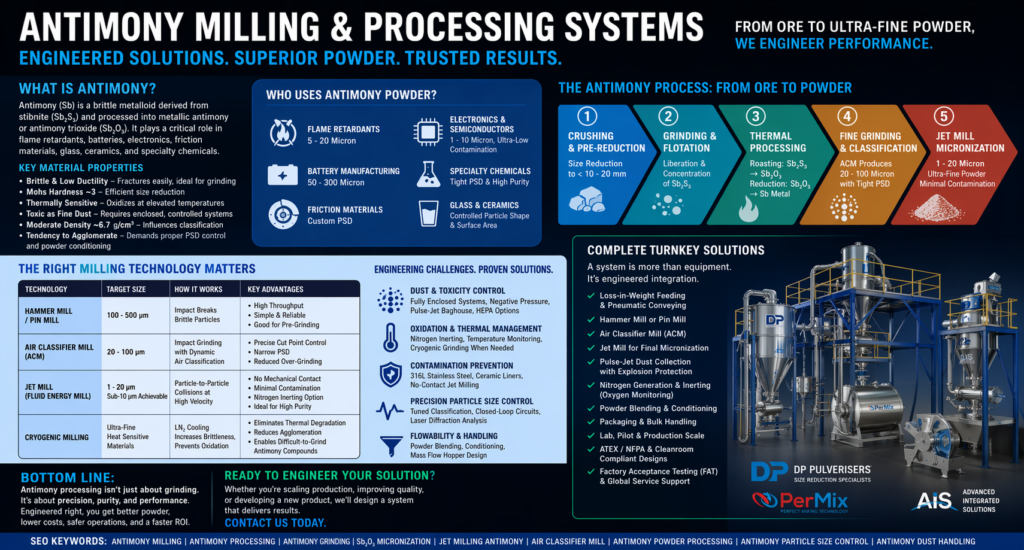
Antimony (Sb) is a brittle metalloid used across critical industries including flame retardants, battery manufacturing, electronics, and specialty chemicals. It is most commonly derived from stibnite (Sb₂S₃) and processed into antimony trioxide (Sb₂O₃) or metallic antimony.
While much of the industry focuses on grinding and micronization, the reality is:
Antimony processing success depends just as much on material handling and system integration as it does on milling technology.
The Hidden Challenge: Handling Antimony Powder
Antimony becomes increasingly difficult to manage as particle size decreases.
At fine and ultra-fine levels, it exhibits:
- Cohesive powder behavior
- Poor flowability
- Dusting and airborne hazards
- Sensitivity to contamination
- Risk of oxidation under heat
This creates a major gap in many systems:
They can grind the material—but they cannot move, control, or contain it effectively.
Where Antimony Is Used (And Why Handling Matters)
Different applications demand different particle sizes—and drastically different handling strategies.
Key Applications:
- Flame retardants → 5–20 µm powders requiring consistent dispersion
- Battery materials → coarser fractions with controlled dosing
- Electronics → ultra-fine, contamination-free powders
- Specialty chemicals → tight PSD and repeatable batching
- Glass & ceramics → controlled particle shape and purity
In all cases, feeding accuracy, dust containment, and flow control directly impact final product performance.
From Ore to Powder: Where Material Handling Comes In
Antimony processing follows a typical path:
- Crushing and pre-reduction
- Grinding and concentration
- Thermal processing (oxide or metal production)
- Fine grinding and micronization
However, between each of these steps lies the real engineering challenge:
Material Transfer & Control
- How is the material fed into the mill?
- How is it conveyed without segregation or dusting?
- How is it discharged and stored without bridging?
- How is it metered into downstream processes?
These are the areas where most systems break down.
Critical Material Handling Challenges in Antimony Systems
1. Dust Containment & Safety
Antimony dust is hazardous and must be controlled at every transfer point.
Solution:
- Enclosed conveying systems
- Sealed transfer interfaces
- Pulse-jet dust collection systems
- Negative pressure design
2. Feeding Accuracy & Consistency
Inconsistent feed rates lead to:
- Poor milling performance
- PSD variability
- Reduced system efficiency
Solution:
- Loss-in-weight feeding systems
- Gravimetric dosing
- Controlled screw feeders for cohesive powders
3. Flowability & Hopper Design
Fine antimony powders are prone to:
- Bridging
- Ratholing
- Inconsistent discharge
Solution:
- Mass flow hopper design
- Agitation or vibration (when required)
- Proper outlet sizing and geometry
4. Pneumatic Conveying Optimization
Improper conveying leads to:
- Particle degradation
- Line blockages
- Excessive dust generation
Solution:
- Dense phase or dilute phase system selection
- Velocity control to prevent attrition
- Proper air-to-material ratio design
5. Contamination Control
Handling systems can introduce contamination if not properly designed.
Solution:
- Stainless steel construction (304 / 316L)
- Sealed systems with minimal exposure
- Clean-in-place (CIP) or easy-clean designs where required
Integrated Antimony Processing System Design
A high-performance system integrates both milling and material handling into a unified solution.
Core System Components:
Feeding & Dosing
- Loss-in-weight feeders
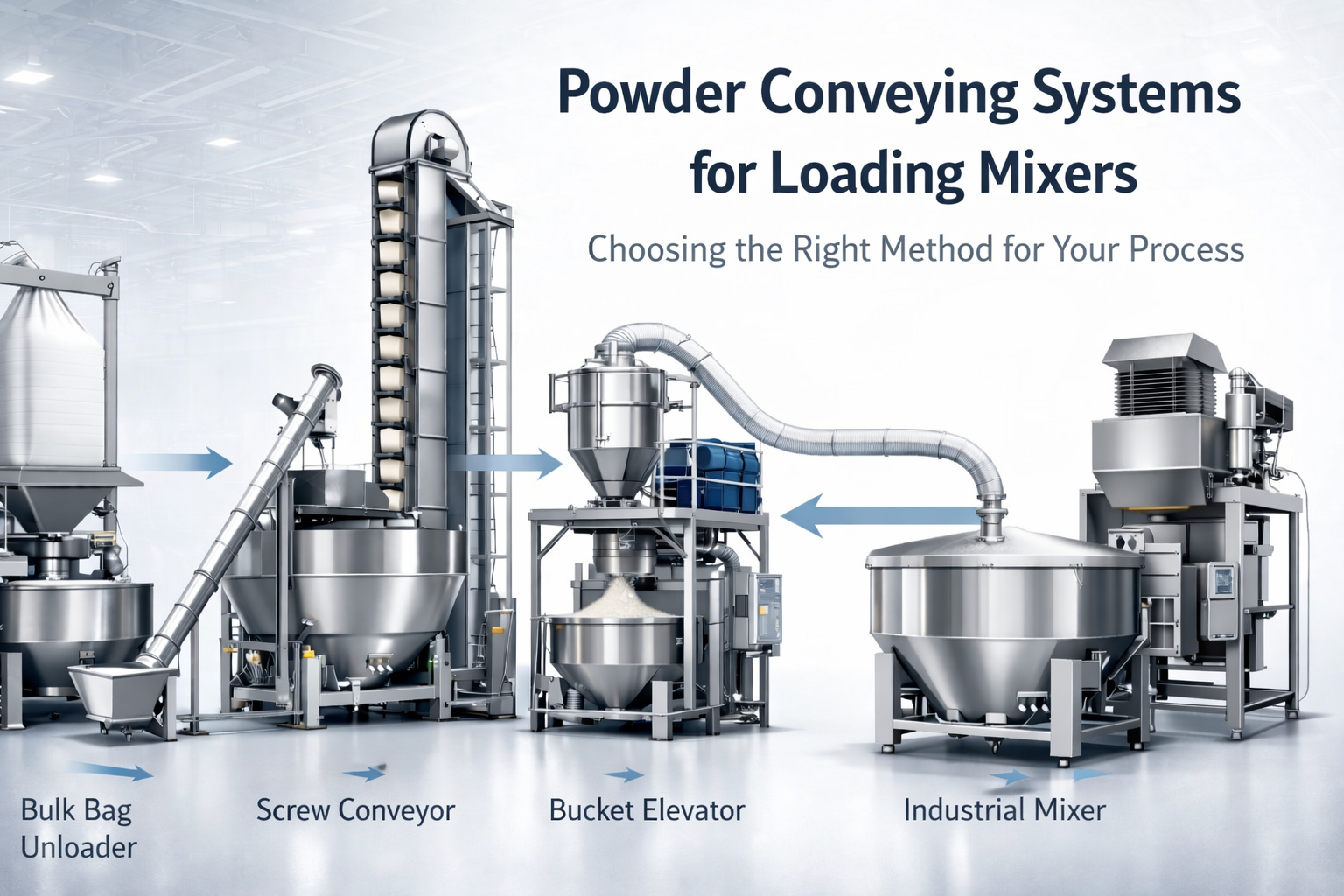
- Bulk bag unloaders
- Screw feeders for controlled discharge
Conveying
- Pneumatic conveying systems (dense or dilute phase)
- Vacuum conveying for contained transfer
Milling Integration
- Controlled feed into ACM or jet mill systems
- Consistent throughput for stable operation
Dust Collection
- Centralized pulse-jet baghouse
- Point-source extraction at critical transfer points
Storage & Discharge
- Silos or hoppers with mass flow design
- Controlled discharge into packaging or blending
Why Material Handling Defines System Performance
Many systems fail not because of poor milling—but because of poor integration.
Common issues include:
- Inconsistent feed rates into mills
- Dust leakage and safety risks
- Powder buildup and system downtime
- Segregation during transfer
- Poor scalability from pilot to production
The result:
- Inconsistent product quality
- Increased operating costs
- Reduced throughput
The AIS Approach: Engineered Integration
At AIS, the focus is on designing systems that ensure:
- Controlled, repeatable material flow
- Safe and contained powder handling
- Seamless integration with milling systems
- Scalable solutions from pilot to production
By integrating with:
- DP Pulverisers for micronization
- PerMix for blending and conditioning
AIS delivers complete, turnkey processing systems—not just individual components.
Applications We Support
- Antimony trioxide (Sb₂O₃) handling and feeding systems
- Battery material processing lines
- High-purity powder transfer for electronics
- Specialty chemical batching and dosing systems
- Integrated milling and conveying solutions
Conclusion: Beyond Milling—Total Process Control
Antimony processing is not just about reducing particle size.
It is about:
- Controlling how material moves
- Maintaining product integrity
- Ensuring safety and containment
- Delivering consistent, scalable performance
Without proper material handling and integration, even the best milling system will underperform.