Loss-in-Weight Feeder vs Gain-in-Weight Feeder
Key Differences, Advantages, and How to Choose the Right System
In modern manufacturing environments, precision ingredient feeding is critical to maintaining product quality, maximizing yield, and reducing waste. Whether you are dosing powders into a mixer, feeding a mill, or controlling inputs to an extrusion line, the choice between a loss-in-weight feeder and a gain-in-weight feeder can significantly impact your process performance.
At AIS (Automated Ingredient Systems), we engineer both systems to deliver reliable, accurate material feeding for industries including food processing, nutraceuticals, chemicals, plastics, minerals, and building materials.
Understanding the difference between these two feeding technologies is the first step toward optimizing your process.
What Is a Loss-in-Weight Feeder?
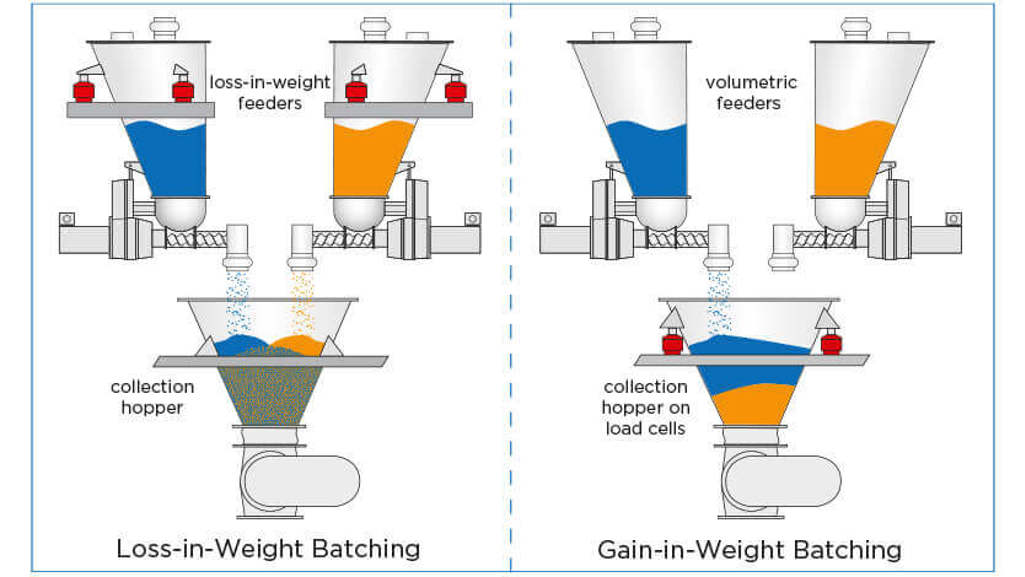
A loss-in-weight (LIW) feeder measures material flow by continuously weighing a hopper mounted on load cells. As material discharges, the system calculates the rate of weight loss over time to determine feed rate.
In simple terms:
The feeder knows how much material is leaving because it sees the weight decreasing.
How It Works
- The hopper is filled with material.
- The hopper sits on precision load cells.
- As material is discharged via a screw or auger, the control system calculates weight loss per unit of time.
- The feeder automatically adjusts speed to maintain a constant, highly accurate feed rate.
Advantages of Loss-in-Weight Feeders
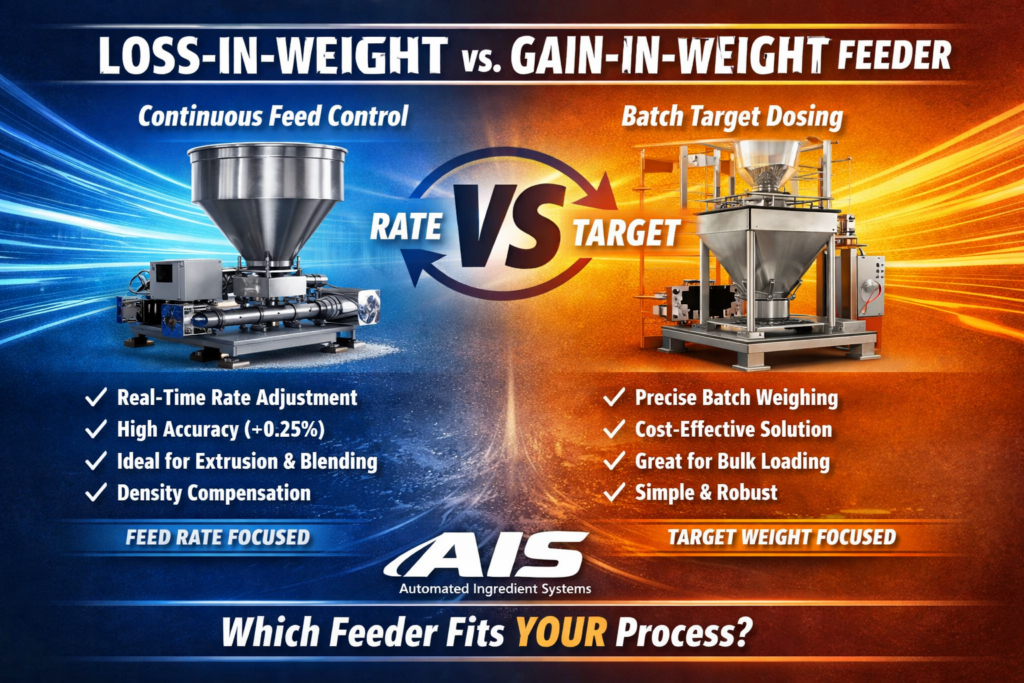
• Extremely high accuracy (often ±0.25% or better)
• True gravimetric control independent of bulk density changes
• Ideal for continuous processes
• Perfect for multi-ingredient blending systems
• Maintains tight process consistency even with material flow variability
Loss-in-weight feeders are commonly used in:
- Continuous mixing systems
- Extrusion lines
- Milling operations
- Nutraceutical and pharmaceutical batching
- High-value ingredient dosing
When precision matters, loss-in-weight systems are often the gold standard.
What Is a Gain-in-Weight Feeder?
A gain-in-weight (GIW) feeder works in the opposite direction. Instead of measuring material leaving, it measures material being added into a container or vessel.
In simple terms:
The system tracks weight increasing as material is filled into a hopper, mixer, or bin.
How It Works
- A vessel or hopper is mounted on load cells.
- Material is introduced into the vessel.
- The system measures weight gain.
- Feeding stops once the target weight is reached.
Advantages of Gain-in-Weight Feeders
• Excellent for batch processes
• Lower cost compared to loss-in-weight systems
• Simple and robust control strategy
• Ideal for bulk ingredient loading
• Highly reliable for large-volume material addition
Gain-in-weight systems are typically used in:
- Batch mixing operations
- Bulk ingredient charging
- Pre-weigh stations
- Loss-in-weight refill stations
- High-volume raw material staging
The Core Difference: Continuous Control vs. Target Dosing
Here’s the practical distinction:
Loss-in-Weight = Continuous, real-time feed rate control
Gain-in-Weight = Controlled batch accumulation to a target weight
If your process demands constant feed rate accuracy over time — such as feeding a twin-screw extruder or continuous paddle mixer — loss-in-weight is typically the right solution.
If your process requires precise batch additions into a mixer or reactor, gain-in-weight may be the most efficient and cost-effective approach.
Accuracy Comparison
| Feature | Loss-in-Weight | Gain-in-Weight |
|---|---|---|
| Feed Rate Accuracy | Very High | Moderate to High |
| Continuous Process Suitability | Excellent | Limited |
| Batch Dosing | Good | Excellent |
| Cost | Higher | Lower |
| Density Variation Compensation | Automatic | Limited |
When to Choose a Loss-in-Weight Feeder
Choose LIW if you need:
• Continuous production
• Multi-ingredient gravimetric blending
• Tight formulation control
• Compensation for material density changes
• Integration with PLC recipe systems
Industries like plastics compounding, food extrusion, protein powder blending, and specialty chemicals benefit heavily from this level of control.
When to Choose a Gain-in-Weight Feeder
Choose GIW if you need:
• Batch accuracy
• Lower capital investment
• Simple integration into mixers or mills
• Bulk material staging
• Pre-weighing before processing
For large-volume dry ingredient loading into horizontal mixers or ribbon blenders, gain-in-weight often provides the best balance of cost and performance.
Hybrid Systems: The AIS Advantage
At AIS, we frequently integrate both technologies into a single automated ingredient system.
For example:
- Gain-in-weight bulk hopper feeding into
- Loss-in-weight precision screw feeders
- Discharging into a mixer or mill
This layered strategy maximizes efficiency, maintains precision, and reduces downtime.
Because loading and unloading times directly affect batch cycle times — something you and I both obsess over — proper feeder selection can increase plant throughput without increasing mixer size.
That’s the kind of systems thinking that separates a component supplier from a process integration partner.
Why Accurate Ingredient Feeding Matters
Inconsistent feeding leads to:
• Off-spec batches
• Waste
• Energy inefficiency
• Poor mixing performance
• Longer cycle times
Accurate feeding improves:
• Product consistency
• Yield
• ROI on processing equipment
• Overall plant efficiency
In high-margin industries like nutraceuticals or specialty powders, even small dosing inaccuracies can cost thousands per shift.
Automated Ingredient Systems by AIS
AIS designs and manufactures:
- Loss-in-weight feeders
- Gain-in-weight feeding systems
- Automated dosing skids
- Bulk handling integration systems
- PLC/HMI controlled ingredient management platforms
Whether you are upgrading an existing mixer line or building a new automated production facility, selecting the correct feeding technology is foundational to performance.
Final Thoughts
Choosing between a loss-in-weight feeder and a gain-in-weight feeder isn’t about which one is better. It’s about understanding your process philosophy:
Do you control by rate?
Or do you control by target?
The right answer depends on throughput goals, product value, process type, and integration strategy.
Precision feeding isn’t just about scales and screws. It’s about mastering material behavior in motion.
And when materials move, margins move with them.