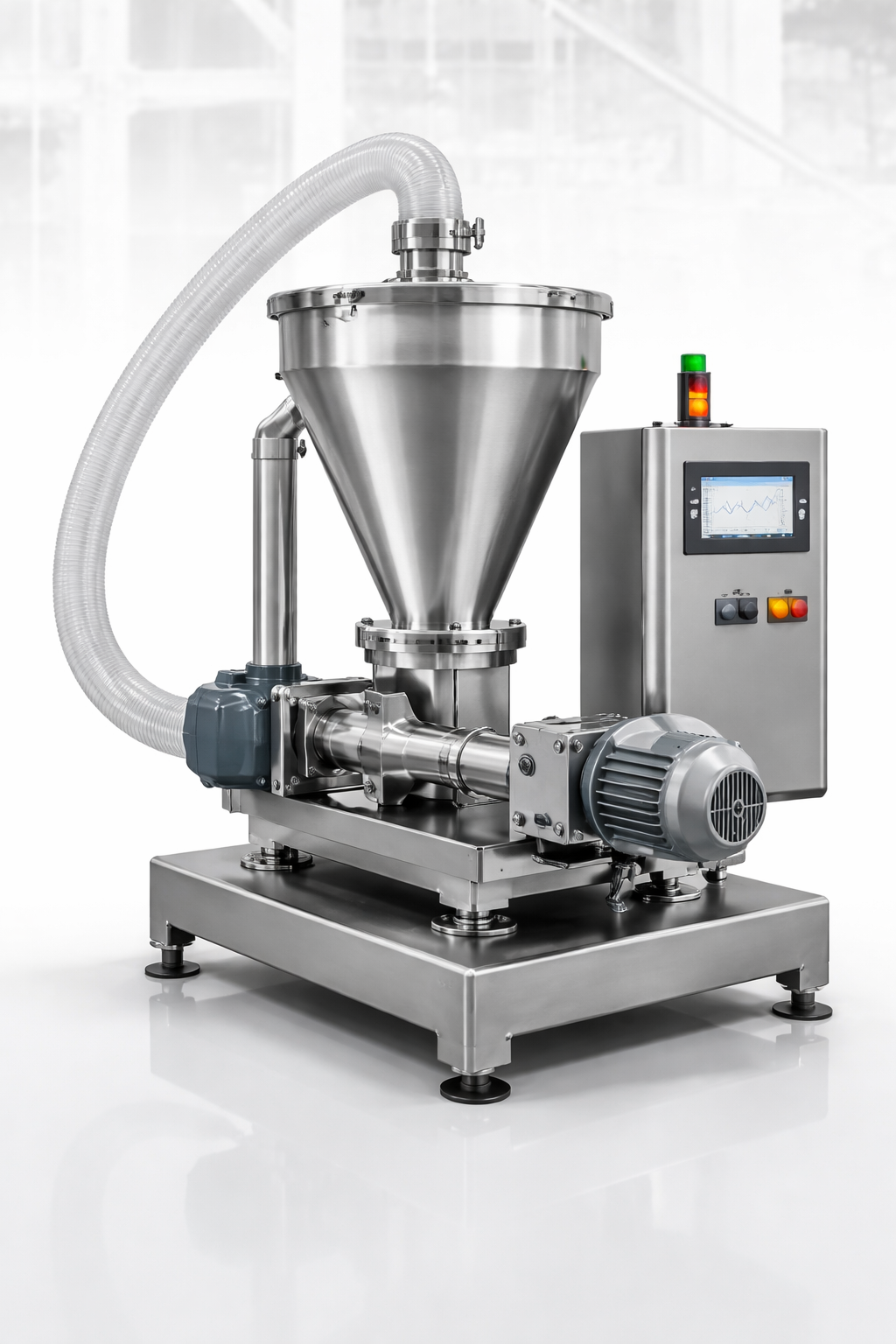
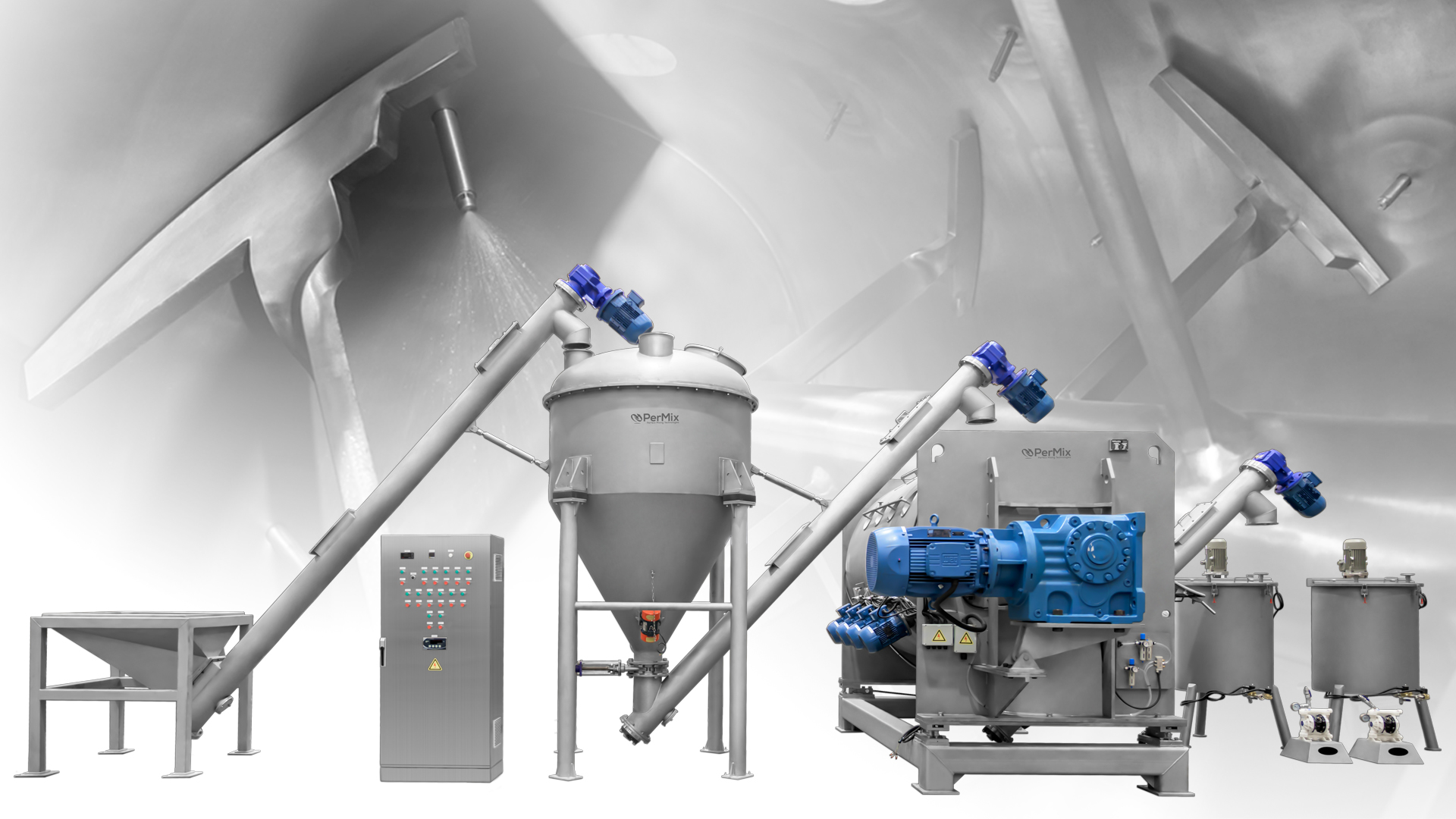
A.I.S. Gain-In-Weight Feeders are engineered for precise, repeatable batch feeding of powders, granules, flakes, and bulk solids. Designed around gravimetric weighing principles, AIS systems deliver exact ingredient quantities while maintaining dust control, hygiene, and seamless integration with conveying and processing equipment.
These feeders are widely used in food & beverage, pharmaceutical, nutraceutical, chemical, plastics, battery materials, and advanced manufacturing applications where batch accuracy is non-negotiable.
What Is a Gain-In-Weight Feeder?
A gain-in-weight feeder measures material as it is added to a receiving vessel or hopper. Unlike continuous loss-in-weight systems, gain-in-weight feeders excel at batching and recipe-based operations, ensuring each ingredient is delivered in the correct amount before the process advances.
AIS gain-in-weight feeders are designed to provide:
• High batch accuracy
• Repeatable recipe execution
• Controlled feed rates
• Minimal product giveaway
• Reliable performance across variable materials
If your process thinks in batches, this is the right language.
Core System Features
AIS gain-in-weight feeders are engineered as complete, production-ready systems:
• High-accuracy load cells
• Rigid, vibration-isolated weighing frames
• Integrated feed hoppers
• Screw, auger, or rotary feeding mechanisms
• Coarse and fine feed control
• PLC-based batch logic and recipe management
Every system is sized based on material behavior, required accuracy, and batch size—not optimistic assumptions.
Feeding Mechanism Options
AIS selects the feeding mechanism to match material characteristics:
• Screw or auger feeders for powders and granules
• Variable-speed drives for fine control
• Flooded or metered discharge configurations
• Flow-assist devices for difficult materials
This ensures stable feeding even with cohesive, aerated, or inconsistent bulk solids.
Easy-Clean & Sanitary Design Options
Batch systems change products often. Cleaning time matters.
AIS Easy-Clean gain-in-weight feeder options include:
• Tool-less access covers
• Pull-out screws and feeder internals
• Quick-release hopper connections
• Smooth, crevice-free product contact surfaces
• Open-frame sanitary construction
These features dramatically reduce downtime, simplify validation, and support allergen control and GMP compliance.
Integration with Conveying & Processing Equipment
AIS gain-in-weight feeders integrate seamlessly with:
• Screw & auger conveyors (including Easy-Clean designs)
• Flexible screw conveyors
• Pneumatic conveying systems
• Mixers, blenders, and reactors
• Extruders and mills
• Packaging and filling systems
Transitions are engineered to maintain accuracy, prevent dust escape, and protect load cell performance.
Dust Control & Environmental Management
Precision feeding fails if dust escapes the system.
AIS integrates dust control directly into feeder design:
• Dust-tight hopper connections
• Integrated dust collection ports
• Filter receivers where required
• Central dust collection system tie-ins
• HEPA filtration for fine or hazardous powders
Clean air and clean data go hand in hand.
ATEX & NFPA Compliance for Hazardous Areas
For combustible dusts and classified environments, AIS gain-in-weight feeders can be designed in accordance with:
• ATEX Zones 20, 21, and 22
• NFPA standards including NFPA 652, 654, 61, 68, and 69
Available safety features include:
• Explosion-proof motors and controls
• Grounding and bonding provisions
• Anti-static components
• Dust-tight construction
• Compatibility with explosion protection systems
Accuracy is meaningless if safety is compromised. AIS engineers both together.
Typical Applications
AIS gain-in-weight feeders are commonly used for:
Food ingredient batching
Nutraceutical and supplement formulations
Pharmaceutical excipients and intermediates
Chemical batching systems
Plastics compounding
Battery and energy material recipes
Pigments, additives, and specialty powders
Anywhere recipes matter, this feeder earns its keep.
Why AIS?
AIS gain-in-weight feeders are designed as precision batch systems, not just hoppers on scales. By combining accurate weighing, stable feeding mechanics, Easy-Clean design, and global safety compliance, AIS helps manufacturers hit recipes exactly—batch after batch.
When ingredients are weighed correctly, the process stops arguing with itself.