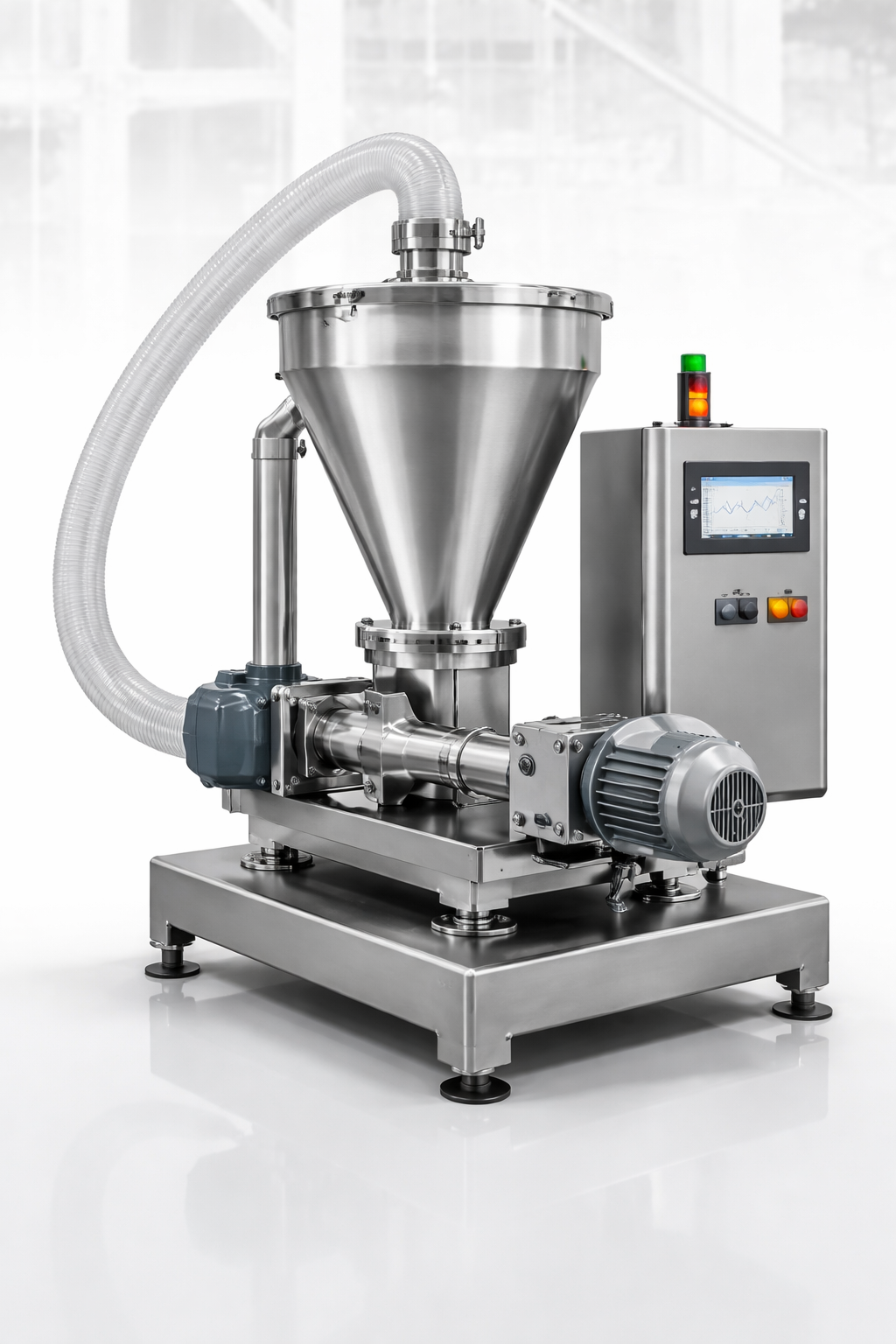
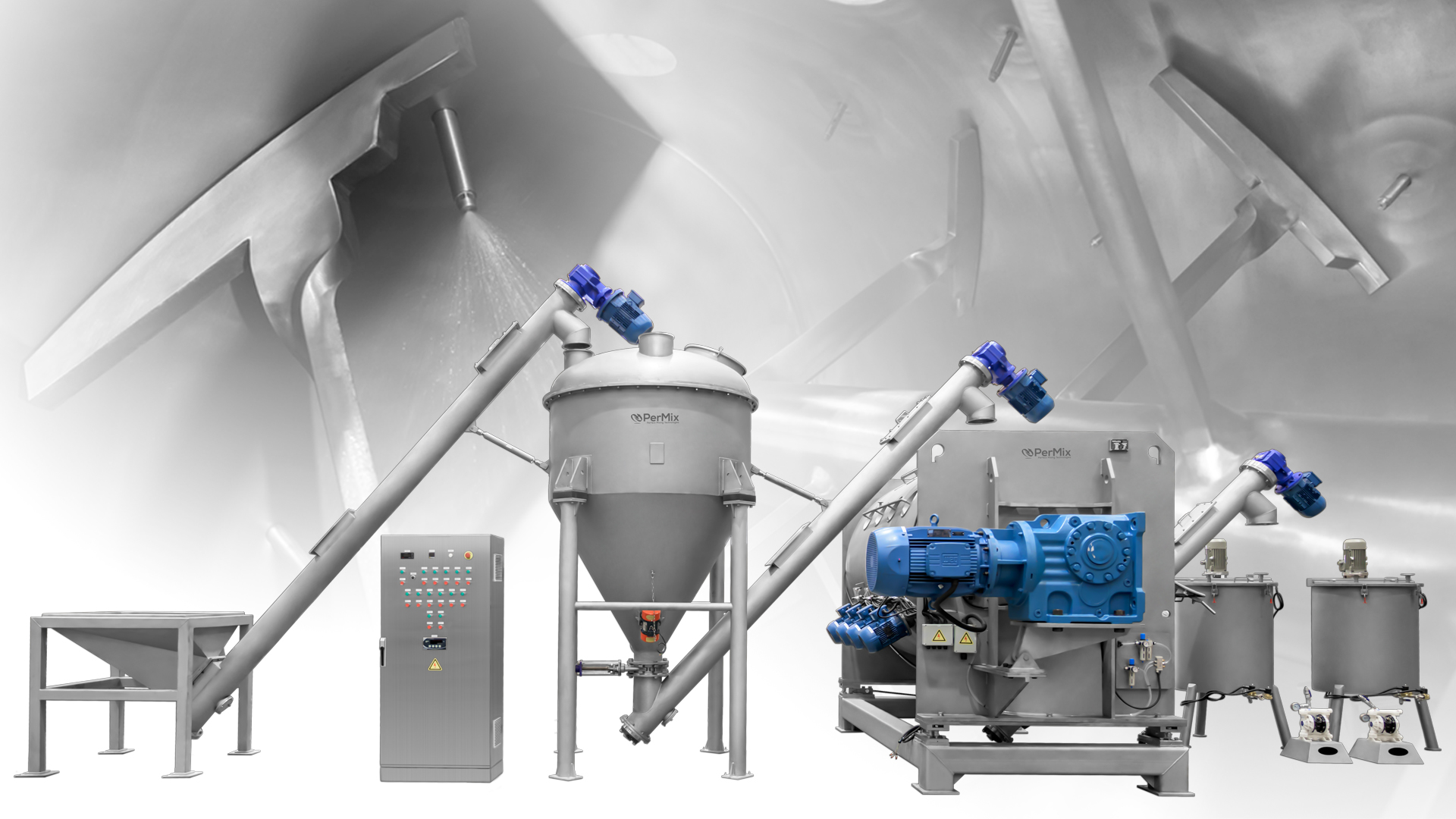
A.I.S. Loss-In-Weight Feeders are engineered for precise, continuous feeding of powders, granules, flakes, and bulk solids. By continuously measuring weight loss over time, AIS systems automatically adjust feed rates to maintain exact mass flow—regardless of changes in bulk density or material behavior.
These feeders are widely used in food & beverage, pharmaceutical, nutraceutical, chemical, plastics, battery materials, and advanced manufacturing applications where uninterrupted accuracy is essential.
What Is a Loss-In-Weight Feeder?
A loss-in-weight feeder measures how quickly material leaves a hopper by tracking real-time weight reduction. The control system continuously adjusts the feeding mechanism to maintain a target mass flow rate.
AIS loss-in-weight feeders deliver:
• High continuous feeding accuracy
• Compensation for bulk density variation
• Stable mass flow over long run times
• Tight process control for critical ingredients
• Smooth integration into automated lines
If your process never stops, this is the feeder that keeps up.
Core System Features
AIS loss-in-weight feeders are engineered as precision, continuous-duty systems:
• High-resolution load cells
• Vibration-isolated weighing frames
• Integrated feed hoppers
• Screw, auger, or rotary feeding mechanisms
• Closed-loop feed control
• PLC-based mass flow control
Systems are designed to maintain accuracy even during long production runs and changing material conditions.
Feeding Mechanism Options
AIS selects feeding hardware based on material characteristics and required feed rates:
• Single or twin screw feeders
• Variable-speed drives for fine control
• Low-shear designs for fragile materials
• Flow-assist devices for cohesive powders
• Flooded or metered discharge configurations
The goal is steady mass flow without pulsing, surging, or compaction.
Refill Strategies & System Stability
Continuous feeding requires controlled refilling to maintain accuracy.
AIS loss-in-weight systems include:
• Automated refill logic
• Refill from bins, silos, or bag systems
• Transition from gravimetric to volumetric mode during refill
• Fast return to gravimetric control after refill
This ensures uninterrupted operation without losing mass flow accuracy.
Easy-Clean & Sanitary Design Options
Continuous systems still need frequent cleaning—especially in regulated environments.
AIS Easy-Clean loss-in-weight feeder options include:
• Tool-less access panels
• Pull-out screws and feeder internals
• Quick-release hopper connections
• Smooth, crevice-free product contact surfaces
• Open-frame sanitary construction
These features reduce downtime, simplify validation, and support allergen control and GMP compliance.
Integration with Conveying & Processing Equipment
AIS loss-in-weight feeders integrate seamlessly with:
• Screw & auger conveyors (including Easy-Clean designs)
• Flexible screw conveyors
• Pneumatic conveying systems
• Extruders, mixers, and blenders
• Reactors, mills, and dryers
• Packaging and forming equipment
Transitions are engineered to preserve weighing accuracy and dust containment.
Dust Control & Environmental Management
Precision feeding requires a controlled environment.
AIS integrates dust control directly into feeder design:
• Dust-tight hopper connections
• Integrated dust collection ports
• Filter receivers where required
• Central dust collection system tie-ins
• HEPA filtration for fine or hazardous powders
Stable airflow equals stable data.
ATEX & NFPA Compliance for Hazardous Areas
For combustible dusts and classified environments, AIS loss-in-weight feeders can be designed in accordance with:
• ATEX Zones 20, 21, and 22
• NFPA standards including NFPA 652, 654, 61, 68, and 69
Available safety features include:
• Explosion-proof motors and controls
• Grounding and bonding provisions
• Anti-static components
• Dust-tight construction
• Compatibility with explosion protection systems
Continuous accuracy means nothing if safety isn’t continuous too.
Typical Applications
AIS loss-in-weight feeders are commonly used for:
Continuous ingredient dosing
Extrusion and compounding lines
Pharmaceutical continuous manufacturing
Nutraceutical blending systems
Chemical reactions and formulations
Battery material production
Plastics and polymer processing
Anywhere material must flow continuously at a precise rate, this feeder excels.
Why AIS?
AIS loss-in-weight feeders are designed as closed-loop gravimetric control systems, not just feeders with scales. By combining precise weighing, stable feeding mechanics, Easy-Clean design, and global safety compliance, AIS delivers continuous accuracy you can trust.
When the process never stops, neither does the control.