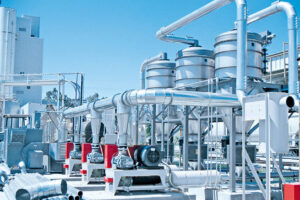
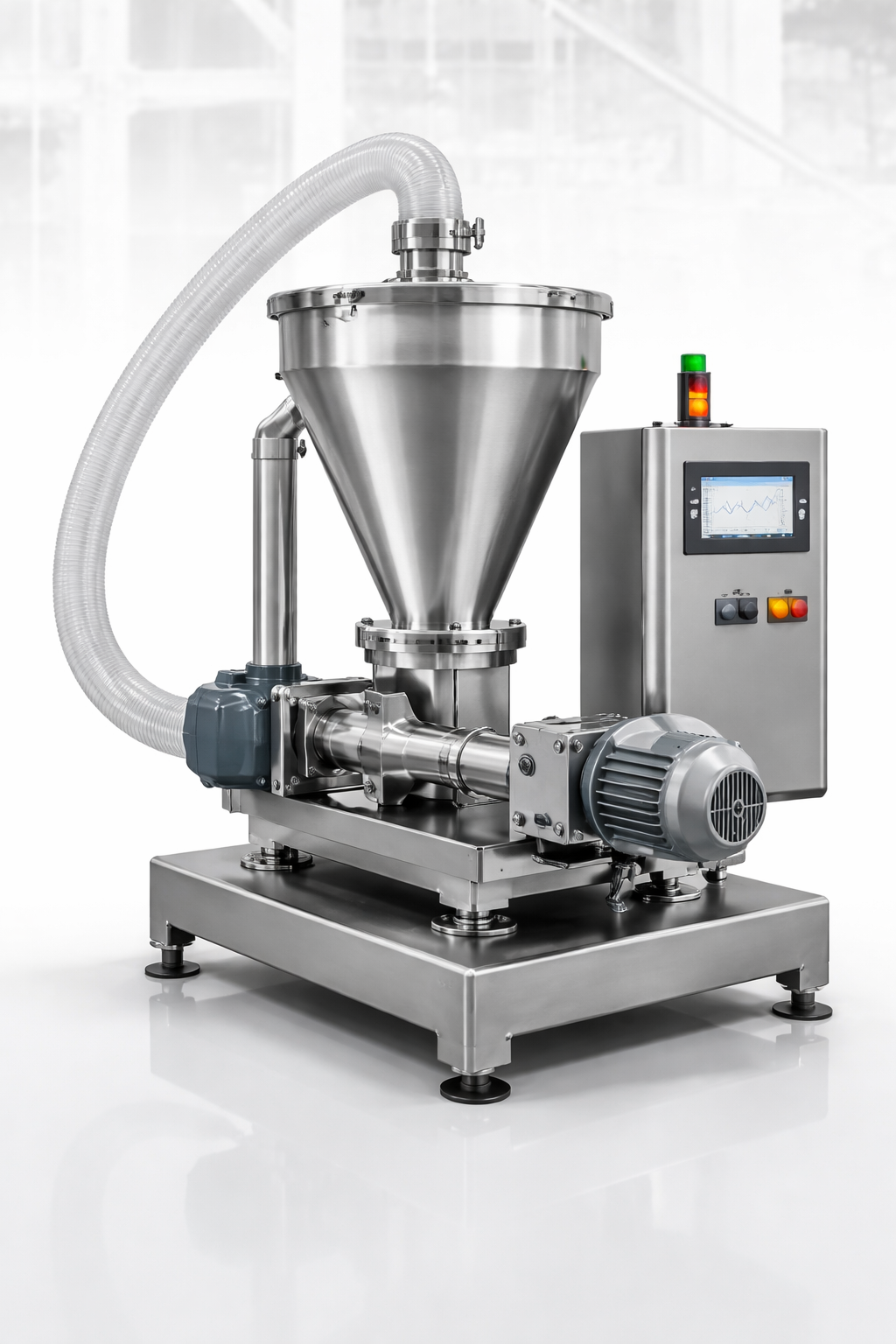
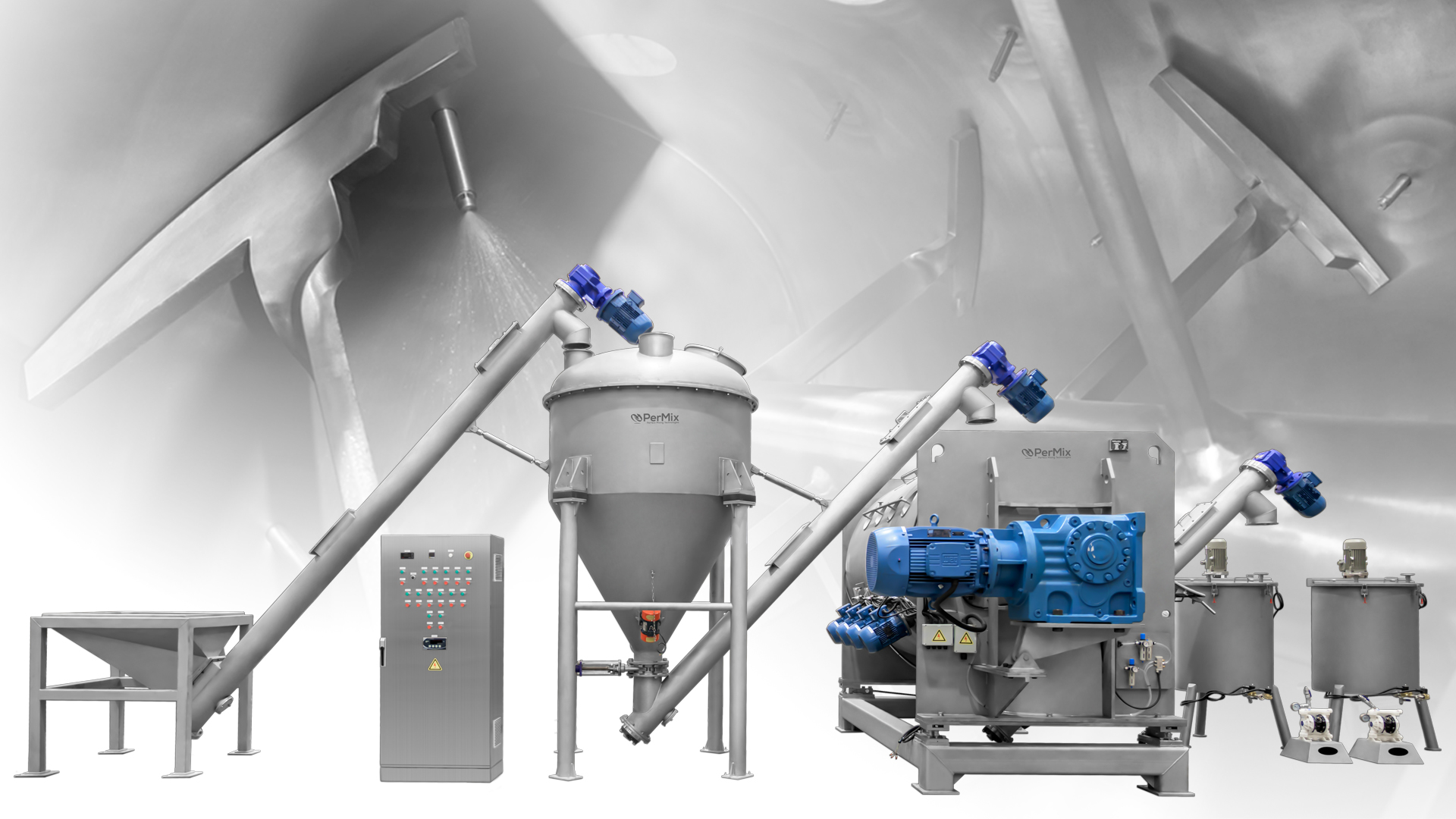
A.I.S. Pneumatic Conveying Systems are engineered to transport powders, granules, pellets, and bulk solids using controlled airflow through sealed pipelines. AIS systems are designed for efficiency, cleanliness, and reliability—moving material long distances while minimizing dust, product degradation, and operator intervention.
AIS pneumatic conveying solutions are used across food & beverage, pharmaceutical, nutraceutical, chemical, plastics, battery materials, and mineral processing industries.
What Is Pneumatic Conveying?
Pneumatic conveying uses air (or inert gas) to move bulk materials through a closed piping system. AIS engineers these systems to control:
• Conveying velocity
• Pressure and airflow balance
• Material integrity
• Dust containment
• Energy efficiency
The result is clean, enclosed transport that integrates seamlessly into automated production environments.
Vacuum vs Pressure Conveying
AIS designs both primary pneumatic conveying methods, selected based on material behavior, distance, and system layout.
Vacuum Pneumatic Conveying
• Ideal for dust-sensitive environments
• Material is pulled from multiple pick-up points
• Lower risk of leaks and dust escape
• Common in food and pharmaceutical applications
Pressure Pneumatic Conveying
• Used for longer distances and higher throughputs
• Material is pushed from a single source to multiple destinations
• Suitable for dense or high-capacity applications
AIS selects the method that fits the process—not the other way around.
Lean Phase & Dense Phase Conveying
Material characteristics determine how air and solids should interact.
Lean Phase Conveying
• Higher air velocity
• Lower material concentration
• Best for free-flowing, non-fragile materials
• Simple system design
Dense Phase Conveying
• Lower air velocity
• Higher material concentration
• Reduced product degradation and pipeline wear
• Ideal for fragile, abrasive, or difficult materials
AIS engineers dense phase systems to preserve product quality while reducing energy and maintenance costs.
System Components Engineered by AIS
AIS pneumatic conveying systems are delivered as fully engineered solutions, including:
• Blowers or vacuum pumps
• Airlocks and rotary valves
• Filter receivers and separators
• Conveying pipelines and bends
• Dust collection and venting
• Controls and automation
Each component is selected and sized as part of a complete system—not as isolated hardware.
Easy-Clean & Sanitary Pneumatic Conveying
Cleaning air systems is notoriously painful. AIS designs them to be manageable.
Easy-Clean and sanitary options include:
• Smooth internal pipeline finishes
• Minimal dead zones and ledges
• Quick-access filter housings
• Tool-less receiver disassembly
• Stainless steel sanitary construction
• CIP-compatible designs (application-dependent)
These options are especially critical for allergen control, GMP compliance, and frequent product changeovers.
Integration with Bulk Handling Equipment
AIS pneumatic conveying systems integrate seamlessly with:
• Bag dump stations
• Bulk bag unloaders and loaders
• Drum dumpers
• Gain-in-weight and loss-in-weight feeders
• Storage bins and silos
• Mixers, mills, extruders, and packaging lines
Transitions are engineered to maintain airflow balance and feeding accuracy.
Dust Control & Environmental Protection
Pneumatic conveying is inherently enclosed—but AIS goes further.
Dust control features include:
• Filter receivers with automatic cleaning
• HEPA filtration where required
• Central dust collection integration
• Dust-tight seals and transitions
• Clean-air return or exhaust systems
Clean air isn’t a bonus—it’s the baseline.
ATEX & NFPA Compliance for Hazardous Areas
For combustible dusts and hazardous materials, AIS pneumatic conveying systems can be designed in accordance with:
• ATEX Zones 20, 21, and 22
• NFPA standards including NFPA 652, 654, 61, 68, and 69
Available safety features include:
• Explosion-proof blowers and motors
• Grounding and bonding provisions
• Anti-static piping and components
• Explosion isolation interfaces
• Inert gas conveying options
Air moves fast. AIS makes sure it moves safely.
Materials Commonly Conveyed
AIS pneumatic conveying systems handle:
Food ingredients and powders
Nutraceutical and supplement blends
Pharmaceutical APIs and excipients
Chemical powders and pellets
Plastics resins and compounds
Battery and advanced energy materials
Minerals, pigments, and abrasives
If it needs to move cleanly without spilling, this is the solution.
Why AIS?
AIS doesn’t design pneumatic conveying systems by guessing air velocity and hoping the elbows survive. Each system is engineered around material behavior, conveying distance, wear, energy efficiency, and safety compliance.
When air is controlled, material follows orders.