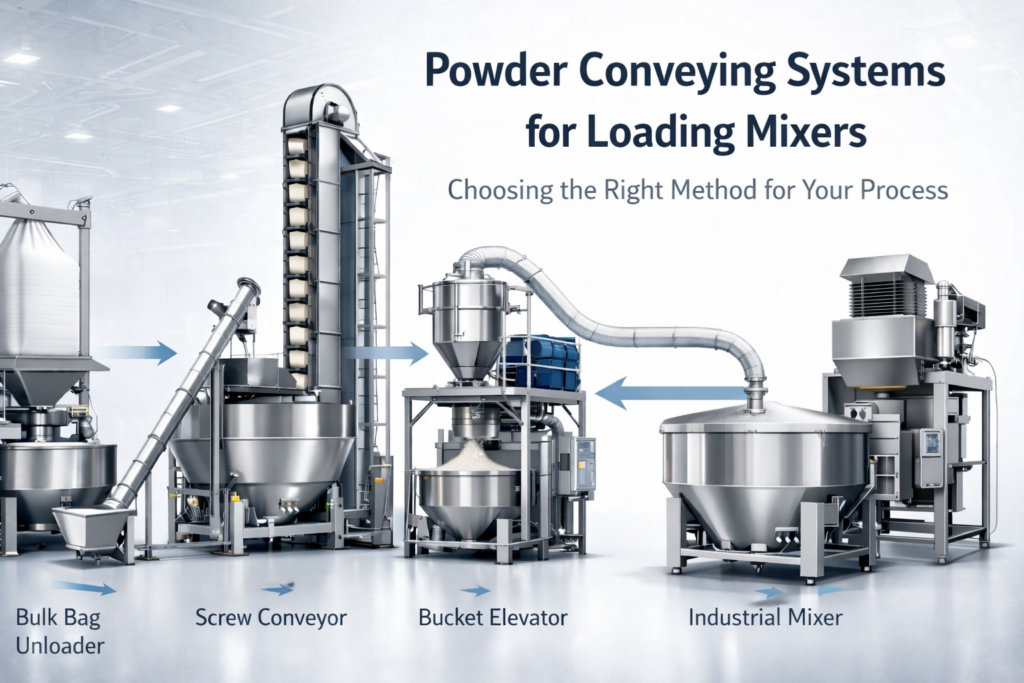
Powder Conveying Systems for Loading Mixers
Choosing the Right Powder Transfer Method for Your Application
In industrial powder processing, the efficiency of a mixing system is heavily influenced by how ingredients are delivered into the mixer. The method used to convey powders impacts production speed, cleanliness, ingredient accuracy, and overall plant efficiency.
AIS designs and integrates multiple powder conveying systems depending on the material characteristics, plant layout, and required throughput. Understanding the advantages and limitations of each method helps manufacturers choose the most effective solution for their operation.
Below are the most common methods used to convey powders into mixers and the applications where each performs best.
Pneumatic Conveying
Pneumatic conveying uses compressed air or gas to transport powders through a sealed pipeline. Material is pushed or pulled through the line and delivered directly into the mixer or storage vessel.
This method is widely used in industries such as food processing, chemicals, plastics, and pharmaceuticals because it allows powders to travel long distances while maintaining a closed and contained environment.
Pneumatic systems provide excellent flexibility for plant layout since pipelines can be routed around existing equipment and structures. They are also capable of moving material vertically and horizontally with minimal mechanical equipment.
However, pneumatic conveying systems typically involve higher installation costs due to piping, blowers, filters, and control systems. Cleaning between batches—especially in allergen-sensitive food applications—can also be more challenging. Additionally, certain powders may experience degradation or minor product loss due to the high air velocities used during transport.
Screw Conveyors
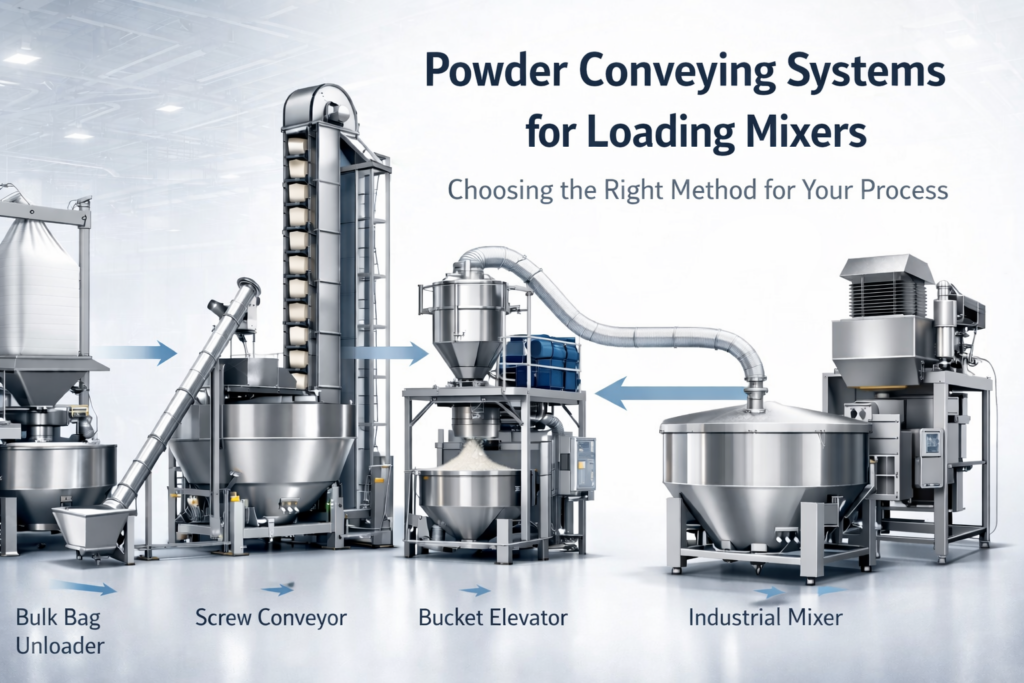
Screw conveyors, often referred to as auger conveyors, move powders using a rotating helical screw inside a trough or tube. As the screw rotates, it gently pushes material forward toward the mixer inlet.
This is one of the most common and reliable methods for loading mixers because it offers precise control over feed rates and minimal product loss. Screw conveyors are also relatively simple mechanically and are easy to maintain and clean.
They can be configured in many ways depending on the application, including:
- Inclined screw conveyors feeding directly into a mixer
- Gain-in-weight batching systems
- Loss-in-weight dosing systems for continuous processing
While screw conveyors provide excellent control and reliability, they generally operate at slower transfer speeds than pneumatic conveying systems and may require additional equipment when long conveying distances are needed.
Bucket Elevators
Bucket elevators are vertical conveying systems that transport powders using a series of buckets attached to a belt or chain. These buckets scoop material at the bottom of the elevator and discharge it at the top.
They are particularly useful when material needs to be lifted to a higher elevation before being discharged into mixers, bins, or storage silos.
Bucket elevators offer high throughput and energy efficiency while minimizing product degradation. Because material moves slowly and gently within the buckets, fragile ingredients can often be handled without damage.
However, bucket systems are partially open during operation, which can create dust generation if not properly enclosed or ventilated. They may also expose product to airborne contamination in certain environments, making them less ideal for highly sanitary processes unless fully enclosed designs are used.
Belt Conveyors
Belt conveyors move material using a continuous belt running across rollers or a flat bed. Powders and granular materials are carried along the belt and discharged into the mixer or downstream equipment.
This method is particularly useful for transporting material across longer horizontal distances within a facility. Belt conveyors are also known for their gentle handling characteristics, making them suitable for materials that are fragile or prone to degradation.
While belt conveyors are effective for moving powders across open plant areas, they are typically less suitable for fully contained systems and may generate dust unless properly enclosed.
Vacuum Conveying
Vacuum conveying systems transport powders through pipelines using suction generated by a vacuum pump. Material is pulled through the pipeline and deposited into the mixer or receiving hopper.
This method is widely used in sanitary industries such as food, pharmaceutical, and nutraceutical manufacturing because it provides a closed, dust-free transfer process that minimizes contamination risks.
Vacuum systems are also relatively easy to integrate with automated batching and weighing systems.
However, similar to pneumatic conveying, vacuum systems involve additional piping and filtration equipment, which can increase installation costs. Cleaning between batches may also require additional procedures when allergen separation is necessary.
Direct Loading with Bag Dump Stations
For operations that require flexibility and precise batching of ingredients, direct loading using bag dump stations is often the most practical solution.
In this method, operators manually load ingredients into a bag dump station equipped with dust collection and screening equipment. The powder is then transferred into the mixer or feeding system.
Direct loading offers several advantages:
- Minimal product loss
- Excellent flexibility for batching multiple ingredients
- Easy cleaning between production runs
- Lower installation and maintenance costs
- Reduced energy consumption compared to pneumatic systems
Many bag dump stations also include integrated sifters or screening systems that remove lumps, agglomerations, and foreign materials before the product enters the mixing process.
While this approach is slower than fully automated conveying systems, it remains one of the most versatile and widely used methods for ingredient loading in batch processing operations.
Selecting the Right Powder Conveying System
Choosing the best conveying method depends on several key factors:
- Powder characteristics (density, particle size, flowability)
- Required throughput and production rate
- Distance and elevation changes between equipment
- Sanitary or containment requirements
- Level of automation required
- Facility layout and available space
AIS works closely with manufacturers to design integrated powder handling systems that combine the right conveying technology with mixers, storage equipment, and feeding systems.
Integrated Powder Handling Solutions from AIS
From bag dump stations and screw conveyors to pneumatic and vacuum transfer systems, AIS provides engineered powder handling solutions that deliver reliable and efficient mixer loading.
By designing the conveying system as part of the overall process, manufacturers can improve plant efficiency, reduce product loss, and ensure consistent mixing performance.
If your operation requires a new powder conveying system or an upgrade to an existing mixing line, the AIS engineering team can help design the right solution for your process.